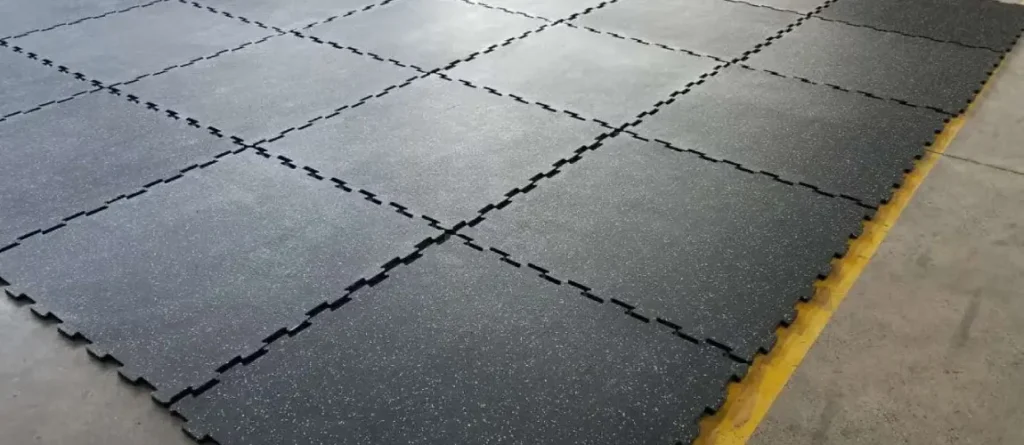
At their most fundamental level, indoor vs outdoor rubber mats differ in their formulation and structural design. Indoor rubber mats are engineered to perform within controlled environments — spaces with regulated temperature, minimal moisture exposure, and predictable foot traffic patterns. Outdoor rubber mats, on the other hand, are built to withstand the unpredictability of the natural world: UV radiation, heavy rainfall, extreme temperature fluctuations, and debris accumulation.
These are not interchangeable products. Using an indoor mat outdoors will likely result in premature degradation, while placing an outdoor mat indoors may be unnecessarily abrasive, visually unappealing, or emit odours from weather-treatment compounds.
Indoor Mats
- Smooth, cushioned surface
- Anti-fatigue & sound absorption
- Available in refined finishes
- Ideal for offices, gyms and kitchens
- Thinner, lighter construction
Outdoor Mats
- UV & weather-resistant rubber
- Deep drainage channels
- Aggressive grip texture
- Ideal for entrances, patios and pools
- Heavier, thicker construction
Indoor rubber mats are designed with comfort and functionality as their primary objectives. They are commonly found in settings such as commercial kitchens, fitness centres, retail stores, warehouses, healthcare facilities and residential homes. Here is what sets them apart:
Anti-fatigue properties
One of the most significant advantages of indoor rubber mats is their ability to reduce physical strain. In environments where employees or residents stand for extended periods, an anti-fatigue mat made from dense, slightly cushioned rubber can markedly reduce lower back pain, joint stress, and general fatigue. This contributes to higher productivity and improved well-being in workplaces.
Slip resistance
Indoor rubber mats typically feature finely textured surfaces that provide dependable traction on smooth interior floors such as tile, hardwood, and polished concrete. This makes them an indispensable safety feature in kitchens, bathrooms, and entryways where moisture may be present.
Noise reduction and floor protection
The dense rubber compound used in indoor mats acts as a buffer between foot traffic, machinery, or equipment and the underlying floor surface. This reduces noise transmission in multi-storey buildings and prevents scratching or abrasion on delicate flooring materials.
Aesthetic versatility
Unlike outdoor mats, indoor rubber mats are available in a far wider range of colours, patterns, and surface finishes — from bevelled edges suited to professional offices to seamless rolls ideal for gym mats flooring. This makes them easier to integrate aesthetically into interior design schemes.
Key Features and Benefits of Outdoor Rubber Mats:
Outdoor rubber mats are engineered to be exceptionally resilient. They are manufactured using rubber compounds that are specifically treated to resist the harshest environmental conditions, making them an excellent investment for any exterior application.
Weather and UV resistance
The rubber formulations used in outdoor mats incorporate UV stabilisers and weather-resistant additives that prevent cracking, fading, and structural degradation from prolonged sun and rain exposure. A high-quality outdoor rubber mat can maintain its integrity for many years with minimal maintenance.
Superior drainage capability
Outdoor rubber mats often feature perforated surfaces or deeply channelled designs that allow rainwater, mud, and debris to drain away from the walking surface. This keeps the mat dry and reduces the risk of slipping — a critical consideration for building entrances, pool surrounds, and outdoor workspaces.
Heavy-duty scraping action
A key function of entrance mats placed outdoors is the removal of dirt, grit, and moisture from footwear before individuals enter a building. Outdoor rubber mats feature coarser textures or raised ridges specifically designed for this purpose — significantly reducing the quantity of debris tracked inside, which protects interior floors and lowers cleaning costs.
Structural robustness
Outdoor rubber mats are constructed with greater thickness and density to withstand the weight and impact of heavy foot traffic, wheeled equipment, and vehicles. Many commercial and industrial outdoor mats are rated for forklift use and can support substantial loads without deforming or cracking.
The decision between an indoor vs outdoor rubber mats ultimately comes down to three core considerations: the environment, the primary function, and the expected level of use. Here is a practical framework to guide your selection:
Quick selection guide
Indoor home gym, office floors, commercial kitchens, retail showrooms, healthcare corridors, warehouse stations
Outdoor building entrances, patios, pool decks, loading bays, car parks, playgrounds, rooftop terraces
Either covered walkways, garages or semi-enclosed workshops — consider both types depending on moisture and sun exposure.
If your space is a transitional zone — such as a covered entrance, a garage, or a semi-enclosed corridor — carefully assess whether the area is exposed to direct rainfall or sunlight. If any outdoor exposure is present, defaulting to an outdoor-rated mat is the safer, more cost-effective choice in the long run.
Both indoor and outdoor rubber mats are relatively low-maintenance, but their cleaning and care requirements differ. Indoor rubber mats can be vacuumed or mopped with a mild detergent solution and should be allowed to dry thoroughly before use to prevent mould growth beneath the mat. They should be periodically lifted to inspect and clean the underlying floor surface.
Outdoor rubber mats benefit from regular hosing down with water to remove accumulated dirt and debris. In areas with heavy rainfall, perforated mats with self-draining properties require less frequent maintenance. Periodic inspection for any signs of UV degradation, surface cracking, or curling edges is recommended, particularly in regions with extreme climate conditions.
There is no universal winner in the indoor versus outdoor rubber mat debate — the best mat is always the one designed for the specific demands of the space it occupies. Indoor rubber mats excel in comfort, aesthetics, and noise reduction, making them the superior choice for controlled interior environments. Outdoor rubber mats outperform in durability, weather resistance, and scraping functionality, making them indispensable for any exterior or high-exposure application. For a deeper look at materials, pricing, and selection tips, check out our complete guide to
choosing rubber mat size guide.
There is no universal winner in the indoor versus outdoor rubber mat debate — the best mat is always the one designed for the specific demands of the space it occupies. Indoor rubber mats excel in comfort, aesthetics, and noise reduction, making them the superior choice for controlled interior environments. Outdoor rubber mats outperform in durability, weather resistance, and scraping functionality, making them indispensable for any exterior or high-exposure application. For a deeper look at materials, pricing, and selection tips, check out our complete guide to choosing rubber mats in Dubai.